



|
|
|
|
|
Sewing and Needlecrafts |
    |
|
Cover
to Cover.. 252 Balmoral Drive, Southport
PR9 8QA, UK.. Tel. 44 (0)1704 231443..
E-mail covers@freeuk.com |
| The sewing machine joins what the scissors have cut asunder, plus whatever else comes in its path. Mason Cooley |
 |
 |
 |
 |
 |
 |
 |
 |
 |
 |
 |
 |
 |
 |
 |
 |
 |
 |
 |
 |
 |
 |
 |
 |
| Author
not given:ooooooooooooooooooooooooooooooooooooClick
on book image for larger version |
|||
 |
The
Vogue/Butterick Step-by-Step Guide to Sewing Techniques |
£22.00
|
|
McCall's
Step-by-Step Sewing Book |
£3.00 |
||
| The
Vogue/Butterick step-by-step guide to sewing techniques |
£22.00 |
||
Coats
Sewing Group Book No. 1083 - 32 embroidery stitches 2 |
£1.50 |
||
| A
Manual of Domestic Sewing Machines S D L Ltd no date 8vo stapled book 84pp F 140 gms (Order reference 6989). |
£5.50 |
||
 |
The
Complete Book of Sewing Colour Library Direct 1998 lrge 4to, glazed pict bds, d/w price-clipprd o/w F/F 1550 gms (Order reference 4483). |
£12.50 |
|
| Sewing
- The Complete Guide HP Books 1983 large 4to pb 176pp, v min wr to edges of cvrs + 1 tiny crse o/w VG++ 515 gms (Order reference 5410). |
£6.00 |
||
| The
Merehurst Book of Needlework Merehurst 1st 1993 square format 4to, top r h cnr of fep mssg, glazed pictorial boards in similar d/w VG++/VG++ 990 gms (Order reference 6230). |
£13.50 |
||
| Florentine
Embroidery - Coats Sewing Group Book No. 1069 Coats Sewing Group 1968 4to stapled magazine type booklet 42pp VG+ 100 gms (Order reference 7993). |
£4.00 |
||
| Coats
Sewing Group Book No. 1067 - 32 embroidery stitches 1 Coats Sewing Group 1967 16mo stapled softcovers 21pp F 25 gms (Order reference 10840). |
£1.50 |
||
Aitken,
Leila: Simply Sewing |
£3.50
|
||
 |
Anderton,
Johana Gast: Sewing for 20th Century Dolls
Volume II 300 plus projects |
£95.00 |
|
|
|
|||
| Babington,
Audrey (ed): The Pincushion Book
Workbox Enterprises 1st 1991 8vo, glazed pictorial boards F 380 gms (Order reference 13961). |
£6.50 |
||
| Benton,
Kitty: Sewing Classic Clothes for Children
- Illustrated step-by-step instructions and techniques Hamlyn (date?) 4to, wr, chips + crsing to d/w, title p mssg o/w VG++/VG+ 980 gms (Order reference 7440). |
£5.00 |
||
| Bridgeman,
Harriet & Drury, Elizabeth: Needlework
- an illustrated history Paddington Press 1st 1978 4to, v v min bmps + wr to bds, v v min crsing to d/w 1540 gms (Order reference 4419). |
£35.00 |
||
 |
Butler, Anne:
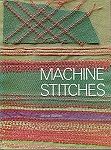
Machine Stitches B T Batsford 1st 1976 4to F/VG++ 465 gms (Order reference 6805). An enormous variety of effects can be achieves by manipulating the tension or speed, using various types of fabrics and fitting different attachments to the modern domestic zigzag/straight stitch sewing machine. This is the first book to explain, with the help of some superb photography by Terry Waddington, how these effects can be achieved. The result is an important contribution to the use of the sewing machine. The book includes sections on Straight Stitch, Zigzag Stitch, Straight Stitch and Zigzag Stitch, Unusual Fabrics and Threads, and Attachments. There is also a book list for further reading and names and addresses of suppliers of equipment and materials, Anne
Butler emphasises that the examples are only starting points, and that
the embroiderer herself will discover many more effects which can be produced
by experiment both with the machine and with the materials that are used. |
£15.00 |
|
| Carbone,
Linda: Dictionary of Sewing Technology Arco Publishing 1st 1977 8vo, v v min mrks to bds, min wr to d/w o/w VG+/VG+ 375 gms (Order reference 5997). |
£12.00 |
||
| Cauter, Gaynor
(ed): Sewing for Children - party dresses,
track suits, quilted anoraks W I Books 1st 1982 4to stapled softcover, ex college lib, 128pp VG+ 120 gms (Order reference 10007). |
£4.00 |
||
| Coleman,
Anne: The Creative Sewing Machine B T Batsford 2nd paperback edn 1986 4to pb 120pp VG++ 345 gms (Order reference 11900). |
£2.00 |
||
| Coleman, Anne:
The Creative Sewing Machine B T Batsford 1st in pb 1981 4to pb 120pp, sl wr + sunning to cvrs, tiny area of delamination to btm corner of fr cover o/w VG+ 365 gms (Order reference 8281). |
£3.50 |
||
| Courtney,
Gretel: The Butterick Sewing Machine Handbook
- an illustrated consumer's guide to buying, using and caring for any sewing
machine Butterick 1977 8vo pb 192pp, slight wr to edges of cvrs o/w VG+ 245 gms (Order reference 6801). |
£5.00 |
||
| Cream, Penelope
(senior ed): The Complete Book of Sewing -
a practical step-by-step guide to sewing techniques Dorling Kindersley 1996 4to, glazed pictorial boards in a similar d/w, v,v min bmps to bds, v v min wr + crsing to d/w o/w VG++/VG++ 1600 gms (Order reference 11850). Whether you are just starting out or are a confident sewer wishing to add a professional touch to your work, this is the only sewing book you will ever need. The Complete Book of Sewing covers every technique you need for dressmaking and sewing for the home, from choosing the right fabric, through pleating and lining, to achieving couture finishes. With this practical sourcebook at your fingertips, you will be able to create your whole wardrobe or give a room a fresh look with new curtains and cushions. Each technique is illustrated with step-by-step colour photographs so that you can see exactly what to do. Throughout the book, supplementary artworks and special tip boxes make the techniques even clearer and show you shortcuts and "tricks of the trade". The Complete Book of Sewing shows you which tools you need for each technique and includes invaluable information on using a sewing machine or overlocker; how to choose a pattern, alter it to fit and apply it to your fabric; and how to identify the fabric hat is best for your needs. Whether
you want to patch your favourite jeans, create a pair of curtains or alter
a tailored jacket, The Complete Book of Sewing is the place to start. |
£10.00 |
||
| Curry,
Jennifer: Cashing in on Needlecrafts David & Charles 1985 4to pb 136pp VG++ 505 gms (Order reference 13397). |
£2.50 |
||
 |
Eaton,
Jan: The Complete Stitch Encyclopedia - over
700 unique full-colour step-by-step photographs Ward Lock 1st 1989 4to paperback 131pp F 590 gms (Order reference 7918). |
£8.00 |
|
 |
Eaton,
Jan: The Encyclopedia of Sewing Techniques
PAR 1st 1989 4to, glazed pictorial boards in a similar d/w F/VG++ 840 gms (Order reference 8366). This is the book for everyone who enjoys home sewing—a comprehensive manual for all types of sewing, from making clothes, to curtains, to fine needlework. Each technique is fully explained and accompanied by clear illustrations, many of them in colour. Opening with a chapter on sewing machines—how to choose one, how to operate it, and the other essential sewing equipment which will be needed—the book then moves on to discuss fabrics. There is a detailed directory of the numerous fabrics available, with information on how they are made and what they are suitable for, as well as hints on how best to care for each fabric. "Basic Sewing Techniques" explains the different methods that are used to make garments and furnishings for the home, dealing with hand sewing and the constructional elements of sewing: seams, hems, shaping and fastenings. Here, as throughout the book, each step of the way is carefully explained and illustrated. For many people, an interest in sewing arises out of the desire to need to make clothes for themselves and their family: the garments are individual, less expensive, fit better, and there is an enormous choice of fabrics and colours available today. "Making Garments" takes you through the intricacies of paper patterns, and gives instructions on making collars, sleeves, waistbands and soon, while the following chapter describes how to add a personal touch to your sewing. Choice of colour and pattern, and techniques of decoration such as embroidery and applique are covered, all helping you develop your personal style. The final chapter deals with items of home furnishing—bedlinen, tablecloths, curtains and cushions—and shows you how to coordinate colour schemes successfully. The book is completed with an index. Easy to understand, comprehensive in scope, and generously illustrated throughout, THE ENCYCLOPEDIA OF SEWING TECHNIQUES is an essential addition to every homemaker's bookshelf. 
 |
£10.00 |
|
|
Eaton,
Jan: The Encyclopaedia of Sewing Techniques
|
£6.00 |
|
|
Eaton,
Jan: The Encyclopaedia of Sewing Techniques
Guild 1986 4to, glazed pictorial boards in similar d/w, v v vmin bmps + wr to bds o/w VG++/VG++ 800 gms (Order reference 5418). This is the book for everyone who enjoys home sewing—a comprehensive manual for all types of sewing, from making clothes, to curtains, to fine needlework. Each technique is fully explained and accompanied by clear illustrations, many of them in colour. Opening with a chapter on sewing machines—how to choose one, how to operate it, and the other essential sewing equipment which will be needed—the book then moves on to discuss fabrics. There is a detailed directory of the numerous fabrics available, with information on how they are made and what they are suitable for, as well as hints on how best to care for each fabric. "Basic Sewing Techniques" explains the different methods that are used to make garments and furnishings for the home, dealing with hand sewing and the constructional elements of sewing: seams, hems, shaping and fastenings. Here, as throughout the book, each step of the way is carefully explained and illustrated. For many people, an interest in sewing arises out of the desire to need to make clothes for themselves and their family: the garments are individual, less expensive, fit better, and there is an enormous choice of fabrics and colours available today. "Making Garments" takes you through the intricacies of paper patterns, and gives instructions on making collars, sleeves, waistbands and soon, while the following chapter describes how to add a personal touch to your sewing. Choice of colour and pattern, and techniques of decoration such as embroidery and applique are covered, all helping you develop your personal style. The final chapter deals with items of home furnishing—bedlinen, tablecloths, curtains and cushions—and shows you how to coordinate colour schemes successfully. The book is completed with an index. Easy to understand, comprehensive in scope, and generously illustrated throughout, THE ENCYCLOPEDIA OF SEWING TECHNIQUES is an essential addition to every homemaker's bookshelf. 
 |
£6.00 |
|
|
Eaton, Jan:
The Encyclopedia of Sewing Techniques - a
comprehensive manual for all types of sewing Quantum Books 2004 4to, glazed pictorial boards in a similar d/w, v v min indent to fr bd + d/w o/w F+/F 850 gms (Order reference 12326). This is the book for everyone who enjoys home sewing—a comprehensive manual for all types of sewing, from making clothes, to curtains, to fine needlework. Each technique is fully explained and accompanied by clear illustrations, many of them in colour. Opening with a chapter on sewing machines—how to choose one, how to operate it, and the other essential sewing equipment which will be needed—the book then moves on to discuss fabrics. There is a detailed directory of the numerous fabrics available, with information on how they are made and what they are suitable for, as well as hints on how best to care for each fabric. "Basic Sewing Techniques" explains the different methods that are used to make garments and furnishings for the home, dealing with hand sewing and the constructional elements of sewing: seams, hems, shaping and fastenings. Here, as throughout the book, each step of the way is carefully explained and illustrated. For many people, an interest in sewing arises out of the desire to need to make clothes for themselves and their family: the garments are individual, less expensive, fit better, and there is an enormous choice of fabrics and colours available today. "Making Garments" takes you through the intricacies of paper patterns, and gives instructions on making collars, sleeves, waistbands and soon, while the following chapter describes how to add a personal touch to your sewing. Choice of colour and pattern, and techniques of decoration such as embroidery and applique are covered, all helping you develop your personal style. The final chapter deals with items of home furnishing—bedlinen, tablecloths, curtains and cushions—and shows you how to coordinate colour schemes successfully. The book is completed with an index. Easy to understand, comprehensive in scope, and generously illustrated throughout, THE ENCYCLOPEDIA OF SEWING TECHNIQUES is an essential addition to every homemaker's bookshelf.
|
£6.00 |
|
| Evans,
Deborah (ed): The Hamlyn Complete Sewing Course
Hamlyn rep 1992 large 4to, v v min spotting to bds + inside d/w, v v min wr to d/w o/w VG++/VG++ 1285 gms (Order reference 6955). |
£12.00 |
||
| Gostelow,
Mary (ed): Therese de Dillmont's Encyclopedia
of Needlework Volume 1 - Needlework and Embroidery Alphabooks 1st 1982 4to, v min wr to bd edges, uncompleted 'this book belongs to' plate to fr pastedown, v v min wr + sunning to d/w o/w VG++/VG+ 635 gms (Order reference 6252). |
£10.00 |
||
| Henry,
Maxine: The A-Z of the sewing machine B T Batsford 1st 1994 4to pb 112pp F 370 gms (Order reference 10740). |
£7.00 |
||
| Henry, Maxine:
The A-Z of the Sewing Machine B T Batsford rep 1994 4to pb 112pp F 385 gms (Order reference 11326). |
£7.00 |
||
 |
Holmes,
Edwin F: A History of Thimbles Cornwall Books 1st 1985 large 4to, wr + chps to d/w edges + closed trs o/w F/VG+ 1000 gms (Order reference 10114). A History of Thimbles is the most authoritative and comprehensive survey that has been written to date concerning thimbles and their history, and it may well prove to be the definitive work on the subject. The book is aimed both at collectors who want a guide to help them identify their thimbles and find out more about them, and at those who desire a more general history of the subject. Many collectors will be gratified to find that an entire chapter has been devoted to the more popular Dorcas thimbles and that considerable attention has been paid to base metal and to plastic thimbles. It is the author's contention that iron and brass thimbles are in some ways more important than thimbles made of precious metals. Other collectors will welcome the layout of the book which, by having separate chapters for each of the four main thimble producing countries as well as separate chapters for each of the materials from which thimbles are made, provides a ready means of reference. Readers will also appreciate the large number of illustrations, including some taken from manufacturers' catalogues, which have never appeared before. More advanced collectors will revel in the older and rarer material, while at the same time coming to realize that there is always something new to learn and that however good their collections, they remain far from complete. The book will also appeal to students of social history because of the surprisingly important place which thimbles came to acquire in the household as well as their role as an objet de galanterie. But the value of this book is not limited exclusively to its subject matter or the specialized research that lies behind it. Its value also rests on the fact that its author is an active and experienced collector, an enthusiast keen to pass on his knowledge, and someone who is prepared to advise others on every aspect of thimble collecting—including what to look for when buying and what to avoid, how to care for thimbles and even what museums to visit.
|
£80.00 |
|
| Hopkinson,
Judith: Traditional Nursery Patterns (Classic
Knitting and Sewing Patterns) Bloomsbury 1st 1988 min staining to bds, crse to fr d/w foldover o/w VG+/VG+ 640 gms (Order reference 3553). |
£7.50 |
||
 |
Jarnow,
Jill: The Complete Book of Pillow Stitchery
Simon & Schuster 1st 1979 4to, v v min bmps to bds, sl wr + crsing to d/w o/w VG++/VG+ 555 gms (Order reference 7945). |
£16.00 |
|
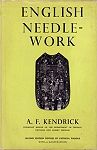 |
Kendrick,
A F: English Needlework A & C Black revised 2nd edn revised by Patricia Wardle 1967 8vo, inscr to fep, d/w price-clipped o/w VG++/VG++ 560 gms (Order reference 7159). |
£18.00 |
|
| Ladbury,
Ann: Sewing Mitchell Beazley 1st 1978 large 4to VG++/VG++ 1275 gms (Order reference 3304). |
£8.50 |
||
| Ladbury, Ann:
The Batsford Book of Sewing BCA 1974 4to, sl sunning to top edge of bds, sunning + fading to d/w o/w VG++/VG+ 745 gms (Order reference 3330). |
£6.50 |
||
| Ladbury,
Ann: The Batsford Book of Sewing
BCA 1974 4to, min wr to bd edges, d/w sp sl sunned o/w VG+/VG+ 750 gms (Order reference 3523). |
£4.50 |
||
| Ollard,
Caroline (introduced by): The Complete Book
of Needlecrafts Caxton 1988 large 4to, v min wr to bd edges, v min wr to d/w edges o/w VG++/VG++ 1400 gms (Order reference 4006). |
£5.50 |
||
| Pearce,
Lynn & Cousins, Gladys (eds): New Sewing
Book Butterick 1956 4to stapled booklet 84pp, wr + crsing to cvrs, cvrs partly detached o/w VG 250 gms (Order reference 5735). |
£3.00 |
||
| Thompson,
Angela: The Complete Book of the Sewing Machine
BCA 1980 4to, v min crsing to d/w edges o/w VG++/VG+ 870 gms (Order reference 8320). |
£9.50 |
||
| Tilling, Meriel:
The Observer's Book of Sewing Frederick Warne 1st 1975 v v min bmps to bds, v min crsing to d/w with 1 tiny tr, price clipped o/w VG++/VG++ 170 gms (Order reference 3177). |
£10.00 |
||
| Tilling,
Meriel: The Observer's Book of Sewing Frederick Warne 1st 1975 16mo, v v min bmps to bds, v v sl wr + v sl dulling to d/w, prize plate to 1/2 title p, book v slightly cocked top to bottom o/w VG++/VG++ 170 gms (Order reference 10355). |
£5.00 |
||
| Veasey,
Christine: Pins & Needles Treasure Book
of Homemaking Christine Veasey Pubs 1st 1955 v min bmps to bds, wr + sl crsing to d/w with sm amts of loss o/w VG+/VG+ 638 gms . Full of plans, themes, motifs and images of the 1950s - ideal for retro enthusiast. (Order reference 2721). |
£10.00 |
||
| Wilding,
Elspeth (ed): Better Homes Sewing Book Collins reprint 1972 4to, cvrs sl dulled o/w VG++ 990 gms (Order reference 9745). |
£2.00 |
||
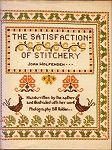 |
Wolfenden,
Joan: The Satisfaction of Stitchery
Peacock Vane 1st 1983 sm date to fep o/w F/F 645 gms (Order reference 3477). |
£10.00 |
|
| TOP |
|
|
|
|